
Walking into a tile showroom is exciting for about ten minutes. Then you’re staring at 47 shades of white marble, a salesperson hovering nearby, and absolutely no idea where to start. Sound familiar?
Choosing the right Bathroom Marble Tiles Design doesn’t have to be that stressful. Once you understand a few key things about your space, your lifestyle, and your budget, the decision starts to get a whole lot easier. This guide walks you through exactly that — no fluff, just the stuff that actually matters.
1. Start With Your Space — Not the Tiles
This sounds obvious, but most people do it the wrong way round. They fall in love with a tile, buy it, and then wonder why their bathroom feels like a furniture showroom after a flood.
Before anything else, measure your bathroom properly. Note where the natural light comes in, where the shadows fall in the evening, and how the room actually feels to stand in. A Bathroom Marble Tiles Design that looks incredible in a sun-drenched showroom can look flat and heavy in a north-facing en suite with one frosted window.
Big rooms can carry large-format slabs — 60×120 cm and beyond. Smaller bathrooms? Herringbone patterns or smaller format tiles will serve you far better. They’re not a compromise; they’re genuinely the smarter choice.
2. Colour: Think Mood, Not Just Aesthetics
People always ask, “Should I go white or grey?” But the better question is: how do you want to feel when you walk in there at 7am?
- White Carrara or light grey marble gives you that calm, airy feel — the sort of bathroom that makes Monday mornings slightly more bearable.
- Warm beige and honey tones feel grounded and cosy — great for family bathrooms that need to feel welcoming rather than clinical.
- Dark marble — charcoal, black, deep brown is genuinely stunning, but it needs decent lighting and regular wiping down. Water marks show up like nobody’s business.
One non-negotiable tip: take physical samples home. The colour you see in a showroom under LED spotlights will look completely different in your bathroom at dusk. Don’t skip this step when finalising your Bathroom Marble Tiles Design — it saves a lot of regret.
3. Veining: The Detail Nobody Talks About Enough
The veining is what makes marble, marble. It’s also where a lot of people go slightly wrong.
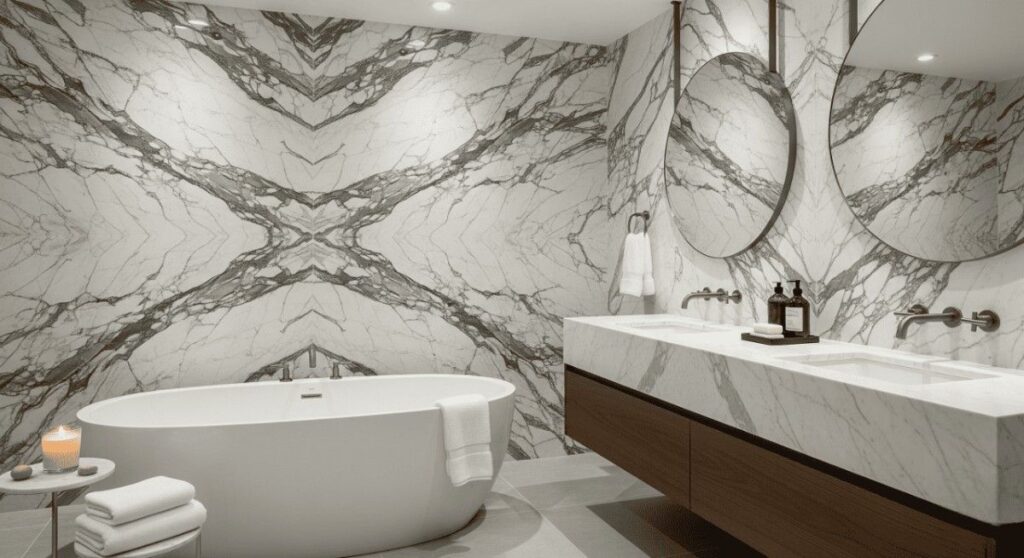
Heavy, dramatic veining — think Calacatta Gold or Statuario — is brilliant as a single feature wall. Behind the bath, behind the basin, as a shower back panel. Give it space to breathe. If you tile an entire small bathroom in bold veining, it stops being a feature and starts being a headache.
For full coverage, choose something with a quieter pattern — honed Carrara, Thassos white, or a soft grey marble with minimal movement. And always — always — make sure your tiles come from the same batch when planning your Bathroom Marble Tiles Design. Marble from different batches can vary quite noticeably in tone.
4. Polished, Honed, or Brushed — Which Finish Is Right?
This is probably the most practical decision in the whole process, and it’s worth getting right.
• Polished looks incredible on walls. On floors? You’ll be skating across it in wet feet. Not ideal.
• Honed is the sweet spot for most bathrooms — smooth but not slippery, elegant but not fussy. Works well on both floors and walls.
• Brushed or tumbled has a more organic, textured feel. Great for rustic or Mediterranean-inspired schemes, and genuinely slip-resistant underfoot.
If you’re tiling a family bathroom that gets heavy daily use, honed is almost always the right call. Save the high-gloss polish for a feature wall where it can really show off.
5. Maintenance: Be Realistic With Yourself
Here’s where a lot of people get caught out. Marble is porous. It stains. It etches. If you use a lemon-scented cleaner on it, you’ll notice it fairly quickly. None of this means you shouldn’t use it — it just means you need to go in with your eyes open.
To keep your Bathroom Marble Tiles Design looking its best:
- Seal the tiles before grouting, and reseal every 12 months or so. It takes 20 minutes and makes a real difference.
- Stick to pH-neutral cleaners. Anything acidic — vinegar, citrus, many supermarket sprays — will dull the surface over time.
- Choose your grout colour carefully. Light grout keeps things refined. Dark grout is bold, but it can look tired if it discolours.
- If maintenance genuinely feels like a lot, consider porcelain marble-effect tiles. Modern ones are remarkably convincing, and they’re virtually indestructible.
6. Mixing Materials: Where the Magic Happens
Some of the most beautiful bathrooms I’ve ever seen don’t use marble everywhere. They use it cleverly.
A honed marble floor paired with a dramatically veined feature wall behind the freestanding bath. White marble tiles offset by brushed brass taps and a raw oak vanity unit. Pale grey marble on the walls, matte black fixtures, concrete-look floor. These combinations work because they give the marble room to be the thing you notice first, without making the space feel like a quarry.
The best Bathroom Marble Tiles Design always has one strong element and everything else supports it. Don’t try to make every surface a statement. Pick your hero and build around it.
So, Where Do You Start?
Honestly? With a notepad and your bathroom measurements. Then go to a proper tile showroom — not just a website — and pick up samples. Live with them for a few days. See how they look in the morning, at night, with steam and condensation on the walls.
The right Bathroom Marble Tiles Design won’t just look good in photos. It’ll make you feel something every time you walk in. That’s what you’re aiming for.
Marble has been used in bathrooms for thousands of years — Roman baths, Renaissance palaces, the loos of five-star hotels. There’s a reason it keeps coming back. Get it right, and yours will still look just as good in twenty years.
